
Spadland no more


Until a few weeks ago I was a Special Adviser, for constitutional and external affairs, to the First Minister of Scotland, John Swinney. (I was also a SpAd to the FM’s three predecessors.) I decided I didn’t want to continue in the role after the recent election, mainly for health reasons which people who know me well will be aware of. I don’t want to sound too presumptuous so it is entirely possible that the FM would also have come to the conclusion that my SpAd days should come to an end. Being a SpAd is incredibly privileged - you get to be at the heart of government with the opportunity to make a difference without having to bother with that troublesome finding-a seat-and-getting-elected business. So I’ll miss the 4th floor of the ministerial tower at Holyrood but my new more leisurely status does allow me to write in my own name about the things I care about most.
Again without presuming that anyone else would be interested in what I write, if you are looking for criticism of the FM (someone who shows that contrary to popular belief kind, decent people can get to the top in politics) or the SNP, then this is not for you. There is a lucrative, if slightly grubby, living to be had, or ego to be massaged, in the Scottish press for anyone with the remotest connection to the SNP who wants to criticise the party and the Scottish Government (evidence of that is being played out right now of course).
The Scottish media is ludicrously and increasingly laughably one-sided on the question of independence in a country where at least 50 per cent of the population supports the idea. Coverage of the recent election tipped over from the usual opposition to the SNP to ever more hysterical demands that voters come to their senses. Alas the electorate failed to follow their instructions and the SNP is back in government along with the largest ever pro-independence majority in the Scottish Parliament’s history. (This won’t be for this substack but Bella Caledonia does a pretty effective job of describing the current sorry state of the Scottish press, including the Frat House boy commentariat with their columns congratulating each other on their astute observations, lamenting the fact the country has gone to the dogs under the SNP’s hideous mis-rule and that voters for some reason or other just can’t see what’s going on.)
Instead I’ll mainly be writing about the economics of Scottish independence (and not entirely coherently with the rest of the substack there will be the occasional post about dog-walking, hill-walking (is there a more gorgeous place on earth than Glencoe?) and the odd piece on cricket.
One thing to get out of the way first: I am of course a believer in independence. This is for the basic reason that Scotland is a country and a democracy. And people in a democratic country should get the governments the electorate votes for. Isn’t that how democracy is supposed to work? I also believe that people in Scotland are best placed to take decisions about the future of Scotland. But as the previous UK Government used to remind us, Scotland has two governments. The problem with that repeated reminder was that one of those those governments - that very UK one - was deeply unpopular in Scotland and had been decisively rejected at the ballot box but held sway over the country anyway. In fact since 1979, and despite never winning an election north of the border in all of that time, Conservative or Conservative-led Westminster Governments from Margaret Thatcher to Rishi Sunak with a bit of Boris Johnson along the way, have governed Scotland for 32 years.
We now have the very real prospect of a Nigel Farage government with the promise of mass deportations of our friends and neighbours on the horizon which from my perspective makes independence more than ever both essential and urgent.
So I approach the economics of independence from the view of wanting it to work and believing it will do. The late academic turned SNP press officer and politician, Stephen Maxwell, once wrote that there was no simple answer to the question of whether Scotland would be significantly better off as an independent country. The evidence of the last couple of decades I think has changed that conclusion: it suggests we would indeed be better off. This will clearly be a different take from Unionist commentators and some others without ostensible skin in the game who say they are taking a more objective view, although without engaging media theory or conducting a Critical Discourse Analysis of claimed objective academic writing, all of our views and experiences of course inform what and how we write and how that writing is received.
So in this first post I want to outline four points that those of us who want to see an independent Scotland, or are open-minded about the prospect, should consider.
(1) Any serious analysis of the Scottish economy needs to recognise the degree to which Scotland is integrated into the UK economy, which means Scotland’s economic performance tends to track the UK’s.
Scotland’s GDP per head, including a geographic share of oil and gas (incidentally that oil and gas qualification shows how even I, a Scottish nationalist, have ingested a particular framing that suggests we need to justify including the economic value of Scotland’s natural resources, in national income calculations) is slightly above the UK’s; our overall GDP is now slightly below. Since the SNP came to power in 2007 our productivity growth has been faster but in recent years tax revenue in Scotland has grown more slowly which, because of the Fiscal Framework in force since the devolution of tax powers, has adverse consequences for public spending.
These graphs (and source notes) taken from a Scottish Government paper published last year show how close the overall long-term trend lines in GDP and GDP per head growth in Scotland and the UK as a whole have been since the establishment of the Scottish Parliament: whether under the Labour-LibDem coalition or since 2007 when the SNP came to power.
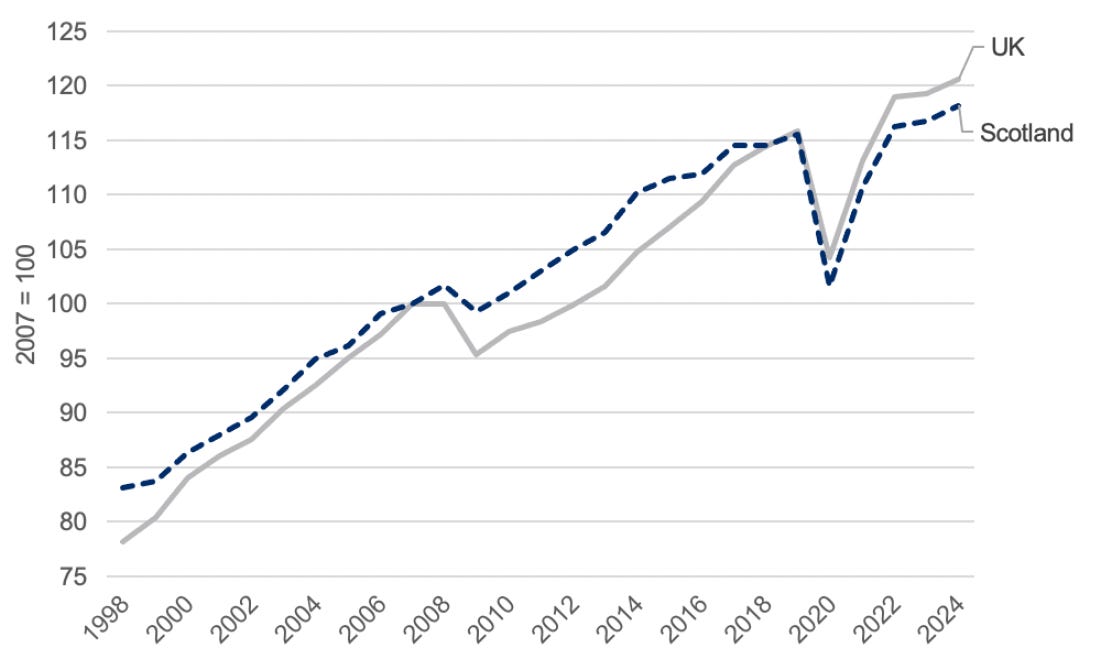
Source: Office for National Statistics, GDP in chained volume measures – real-time database (ABMI) (last accessed 30 September 2025); Scottish Government (2025) GDP First Quarterly Estimate 2025 Q2 (April to June)) (last accessed 30 September 2025)
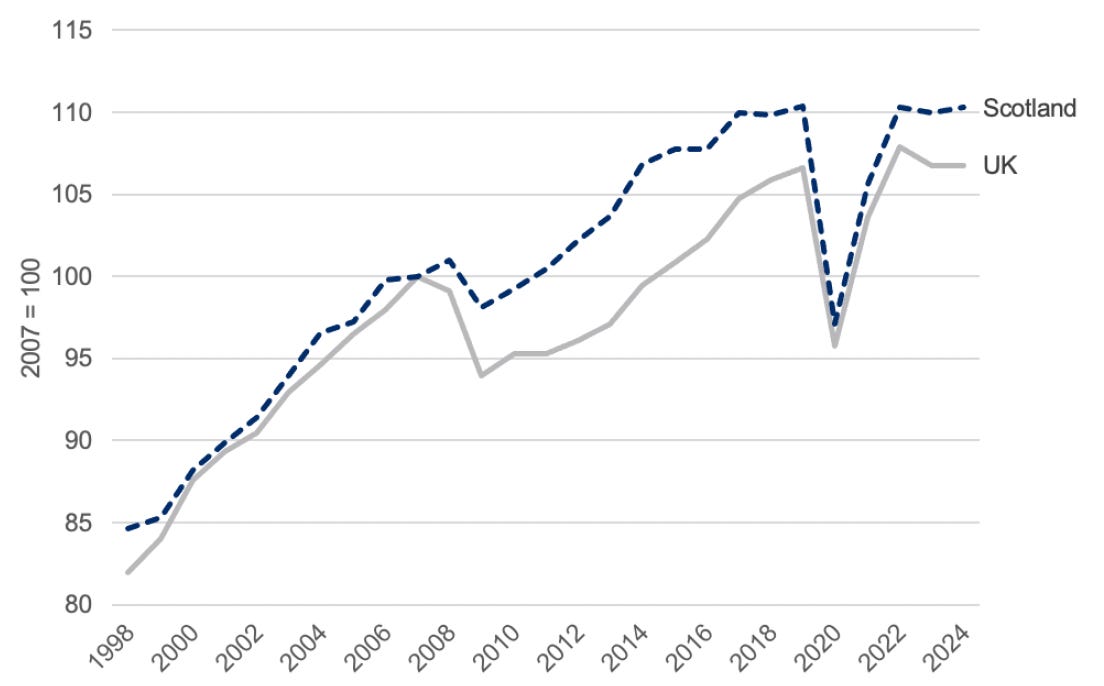
Source: Office for National Statistics, Gross domestic product (Average) per head, CVM market prices (reference year = 2023) £ (last accessed 30 September 2025); Scottish Government (2025) GDP First Quarterly Estimate 2025 Q2 (April to June)) (last accessed 30 September 2025)
(2) The UK is a poor performer. Point (1) would be fine (from an economic point of view if not a democratic one) if the UK was a high performing economy with rising average disposable incomes, high living standards, good productivity growth and low levels of inequality where most people believed if they work hard they will get on in life. I don’t need to rehearse here how that has not been the case since at least the financial crash of 2008. Indeed flatlining real average weekly earnings in Great Britain since the crash explain almost everything about the fractured nature of British politics today.
And there is an historical point to be made here. The economic historian Professor Kevin O’Rourke argues persuasively that for much of its history as an independent state Ireland’s “excessive reliance” on a poorly performing UK before EU accession was a plausible explanation for its own performance. It is striking how the advent of the Single Market and Ireland’s trade diversification away from over-reliance on the UK coincided with its economic take-off.
The reality of Brexit will continue to make it harder for the UK to overcome all its other problems, such as its massive geographic inequality, low levels of business investment and poor productivity record and therefore poses a serious problem into the future for Scotland integrated as it is into the UK economy.
(3) Countries that are comparable to Scotland outperform the UK. Scotland is a country of 5 and a half million people in north-western-Europe. In our European neighbourhood countries with disparate economic models like the Nordics, Ireland, Austria, Switzerland and others do better than the UK. They have higher GDP per head (some of them much higher), higher productivity, higher levels of business investment and lower levels of poverty. They are healthier with longer life expectancy and their populations report higher levels of happiness.
These findings are remarkably consistent over time.
Equally remarkable is the almost total lack of curiosity among almost all of mainstream “serious” (ie Unionist) opinion in Scotland as to why that may be the case. And the fact that all those countries enjoy political independence is something best not talked about in case any unwelcome conclusions may be drawn.
Among those who are indeed interested in the success of small states, the scholar Peter Katzenstein has written extensively on the importance of consensus and social partnership. The consultant David Skilling, who has worked with many “small” country governments including the Scottish Government when I was there, also points to factors such as strong institutions and high levels of trust. I’ll return to these themes in later posts but it is just a fact that independent countries comparable to Scotland tend to do very well - better than we or the UK are currently doing - suggesting importantly that with independence there is genuine catch-up potential. In fact, there would have to be something genuinely odd about people in Scotland were we not to achieve similar success.
(4) This is probably the most important point I’m keen to make: Scotland’s economy is often, incorrectly, talked about as if it was already the economy of a nation state. The Scottish Government produces estimates of GDP, the public finances, our trade performance and some experimental work on a Scottish balance of payments, just as nation states do. Such work is interesting and can be useful. But taking account of points (1)- (3) they actually tell us very little about how Scotland would perform as an independent country. Instead they tell us how Scotland is doing as a so-called devolved nation (I hate that term as much as I hate the UK civil service description of the Scottish Government as a Devolved Administration or “DA”, but we are where we are) within a struggling, larger UK.
Opponents of independence like to cite the public finance estimates and the notional sizeable fiscal deficit as a key part of their case. I see no value in questioning these annual Government Expenditure and Revenue Scotland estimates. They are produced to a high standard by impartial civil servants. But all they really offer is an accurate description of the way the UK economy is run and are a clear example of one of its defining characteristics: the massive over-concentration of economic activity in London. (They also show the success of the Scottish Government in consistent lobbying to prevent the kind of public spending cuts in Scotland we know many in Westminster would like to see. Who knows how long that will continue to be successful particularly if the next UK election results in some combination of Reform and right-wing Tories).
In 2022-2023 for example only London and the South-East of England contributed more tax than they received in spending. To emphasise, this isn’t a quirk, it’s a UK characteristic: a result of political and policy choices and UK economic structure. Scotland’s “deficit” was a little over 10 per cent of GDP, almost all regions of England showed higher figures, with Northern Ireland and Wales approaching 30 per cent. It’s not clear to me how sustainable this model is but it tells us a lot about how the UK economy operates and nothing at all about how the economy of a Scottish nation state would be run.
And let’s be clear there isn’t much Scotland (or any other part of the UK) can do to change this significantly. Indeed the Scottish Government is often told to focus on the powers it has rather than the powers it doesn’t have. Without recognising the contradiction, you’ll also hear ever louder demands from the same people that the SG concentrates on growing the economy while they obstruct the government from gaining the very powers it needs to do so.
It is the UK that has macroeconomic powers, capital borrowing powers, control of trade policy (including of course the decision to remove Scotland from the EU and the Single Market), company law powers, competition policy, employment policy including minimum wage setting, most business taxation including corporation tax and Employers National Insurance, migration policy, the majority of energy powers including consents for North Sea Oil and Gas and most social security powers.
This means the Scottish Government in effect, and courtesy of schedule 5 of The Scotland Act, cannot have an economic policy in the sense understood by normal nation states. Given its powers it has instead a business support policy. There are lively arguments of course over how well or otherwise the SG is pursuing that policy including discussions over business rates, the enterprise agencies and the impact and potential of public procurement. And good business support can help with growth.
But let’s be clear, to take just two examples of UK policy-making, depending on what estimate you prefer, it seems Brexit will continue to knock between around 4 and 8 per cent off UK (and Scottish) GDP compared with what we might have expected with continuing EU membership. That is a very large number. The recent big fall in migration to the UK is also likely to mean a very substantial hit to the Scottish economy. No matter how good the system of non-domestic rates or how well the Scottish Government is at encouraging the right skills for the economy, even the best business support policies are not going to come near compensating for the disasters of Brexit and a UK migration policy designed to ward off the threat of Reform no matter the economic cost to Scotland.
There are therefore clear limits to what can be achieved under the current constitutional arrangements, something incidentally that is not going to be overcome through transferring the odd power from Westminster to Holyrood (and the reality anyway is that because of the little understood Internal Market Act that process is now in reverse). Instead this is about recognising we are talking about two completely different economic and political systems: a devolved nation in the UK or a nation state in the EU. An extra devolved power or two is not going to be a game-changer and can in fact lead to administrative complexity that would not exist with independence.
I plan to write over the summer about what a successful economic policy (which will be bound up with governmental and Parliamentary structures) for a Scottish nation state as an EU member might look like as well as discussing the starting points in relation to currency and the public finances. Point (1) earlier will also need to be addressed as the move to being an independent country means less dependence on a failing UK economic model (a good thing clearly) but also that there will be a transition to be managed.
That is, if I’m not hill-walking, dog walking, cricket watching, World Cup watching or mourning too much about what happened to Hearts at the end of last the season.