
Winning independence: process then substance or substance then process?

For the first time in a long time I’m not the constitution SpAd at the Scottish Government in the week that Government Expenditure and Revenue Scotland (GERS) is published.
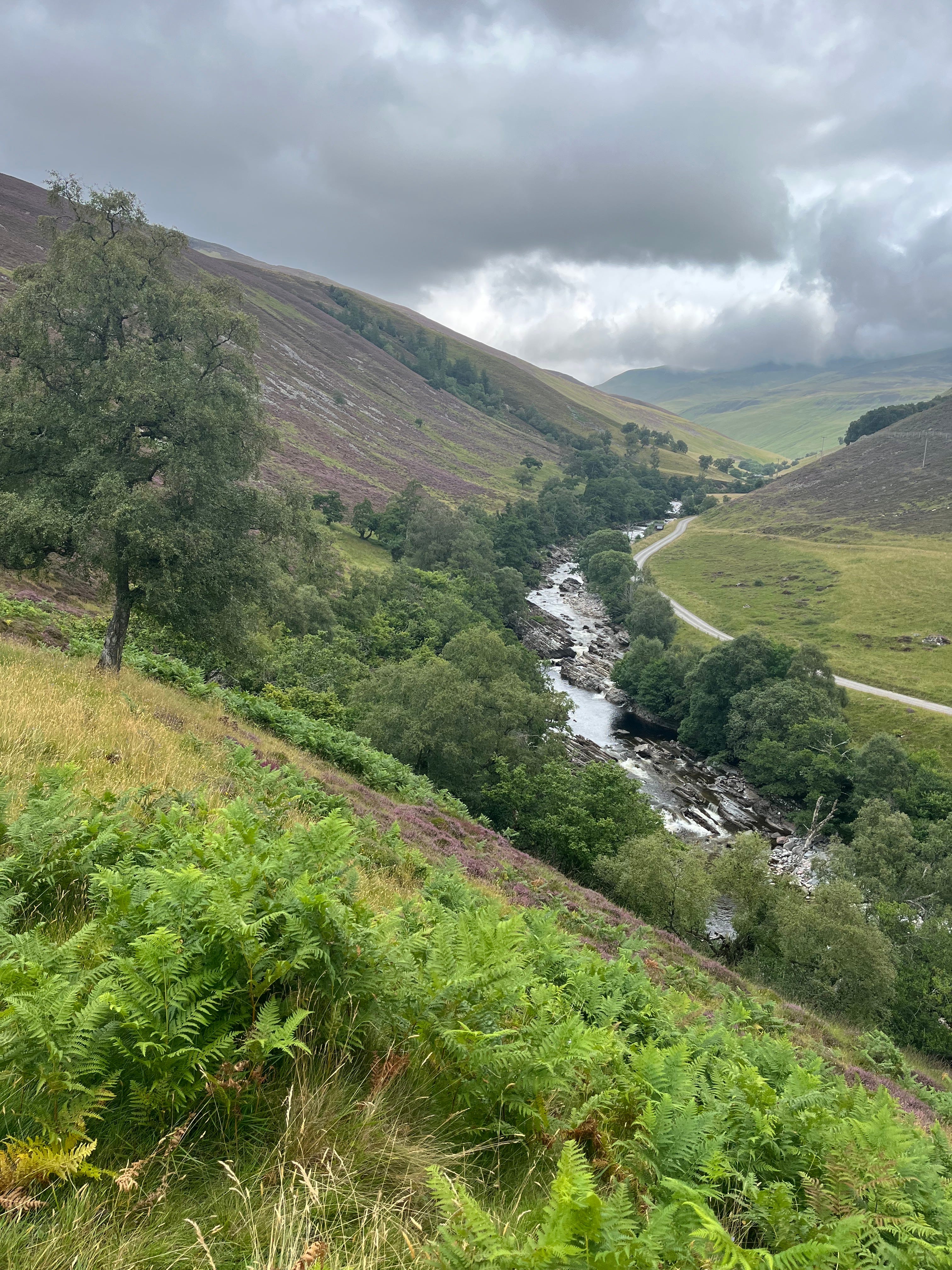
Happily, instead of obsessing over the presentation, I was climbing a Munro (since you ask: Carn a’ Chlamain in beautiful Glen Tilt above) at the same time the government response to the figures for 2025-2026 would have been put together and finalised.
I was going to write about GERS this week - and still will do at some point (I’ve factored in the fall in readership into the business plan).
But for now I can’t do much better than quote the Fraser of Allander: “in short, the GERS data are not a forecast for the public finances of Scotland under alternative constitutional arrangements, nor are they irrelevant to those debates.”
Instead though, and prompted by a chat on my hill-walk (on the geeky side) I’m going to talk about the importance of substance and process when it comes to Scottish independence.
Someone cleverer than me once made the point that substance and process reinforce each other.
If the SNP and Scottish Government just talk about process we (I can’t yet bring myself to say “they” despite now being out of the arena - I’ll get there soon) will be accused of failing to talk about the substance.
If we only talk about substance then we can be met with a shrug - what’s the point if there is no mechanism to actually win independence? (A particularly problematic question if you happen to write a niche substack on the economics of independence.)
But the point is this: in 2014 there was a very lively, informed and widespread debate on the substance of independence because there was an agreed process: a referendum agreed by the Scottish and UK Governments.
In other words people knew they had to make a choice (or sit it out but very few people did with an astonishing 85pc turnout) and therefore there was engagement with the substance.
And that engagement led to increased support for Yes.
The substance wasn’t just the publication in November 2013 of the Scottish Government’s White Paper but more importantly the idea that Scotland could be re-imagined, that our country’s future would be ours to decide, prompting lots of groups and individuals to put forward their own views on the Scotland they thought was possible.
Today there is no agreement on the process - so arguments about the substance can be seen as academic (so from a very personal point of view the corollary being I should stop wasting my time here and go and watch some day time tv).
But to save me from Homes under the Hammer, this is where the mutual reinforcement comes in.
If we are confident about our case then talking about the substance of independence should both drive up support for a Scottish nation state and solidify feelings among those who already say they support it.
That in turn will lead to an agreed process because frankly this is about democracy and faith in democracy is the last thing we should give up on.
In government I was sceptical of a Northern Ireland style model. Northern Ireland is of course a particular case (it has an Assembly in which only 13 MLAs are not actually in parties of government). Moreover under that model it is the Secretary of State who decides if there should be a referendum on Irish unification, albeit he or she has a duty to call one if it seems likely there would be a vote in favour. There might be a claim that the Secretary of State for Northern Ireland can act as a relatively impartial judge on this matter but the idea that the recent holders of the office of Scottish Secretary - Alister Jack, Ian Murray and now Douglas Alexander should be the objective arbiters of whether a particular threshold has been reached is clearly, at the very least - and I’m being polite here - questionable. I’m no less sceptical now. I hold, instead, to the quaint view that if you win an election you are entitled to do whatever you can to put into practice your manifesto commitments.
Winning an election in Scotland on the basis of a commitment to hold a referendum on independence should mean, shock horror, there should be a referendum on independence. And under the astute leadership of John Swinney the SNP won the Scottish election in May (a victory for which the First Minister deserves massive credit) and there is now a substantial pro-independence majority in Holyrood.
The minor difficulty is the Scotland Act reservation of matters relating to the constitution, the UK Supreme Court ruling in November 2022 and the repeated refusal of the UK Government to accept the outcomes of Scottish elections.
Acting outside the law, or indeed an agreed process, is clearly a non-starter (incidentally those who say the Scottish Government should launch a major diplomatic effort to, for example, persuade EU countries to pressure the UK into granting us a referendum really need to come back into reality. EU member states will be very open to an application from a newly independent Scotland but they are absolutely clear this has to be an internal UK/Scottish matter and that any process must be agreed and constitutional. Inconvenient maybe but there you go).
Although as a further aside I note this from The Economist this week in a piece about the renewed debate in Iceland over whether to become an EU member: “For the EU, the prospect of a new recruit on the north-western periphery is welcome. Iceland has an income per head well above the EU average and much of the accession homework has already been done. The European Commission has said there is “room for flexibility” on fishing rights.” Some interesting observations there for another country on the north-west periphery perhaps.
So this brings us back to substance - continually, confidently making the evidence based case so that more voters than now believe independence to be, as another clever person once put it to me, not a luxury good, but an essential one.
This in turn will lead to voters basically demanding independence at election time and indeed between elections, not just voting for it. In those circumstances it seems to me, as someone who refuses to give up on democracy, it will be impossible for any UK Government to say no.
So an intense concentration on substance will have led to agreed process.
The big difference is that the economic case in particular is now becoming more and more compelling and urgent, not to mention the prospect of some right-wing Farage/Lowe/Badenoch nightmare administration coming down the track from Westminster to concentrate minds.
This also means of course engaging with topics such as GERS for longer than just the annual spin war because to go back to the Fraser of Allander it isn’t irrelevant to constitutional debates (for example, the principle mainstream argument advanced against the sensible Scottish Government policy of continuing to use the pound sterling (before moving to a Scottish pound as soon as practicable) is the idea that an independent Scotland would initially face a twin deficit: the fiscal deficit and a balance of payments deficit. I’ll address those issues in later posts).
In addition the prospect of an economic turn around for the UK is looking more remote than ever. Advanced economies in general are struggling to boost growth rates (AI potential notwithstanding) but on top of that, the UK has decided to leave the EU, go all out for very low or zero net migration and over decades has built an economic model massively over-concentrating activity in London which, Andy Burnham-style enthusiasm for devolution or not, cannot be jeopardised for fear the whole house of cards will collapse. It doesn’t look like a happy future.
Scotland, of course, is also an advanced economy but has clear catch-up potential with comparable independent European nations, can build on its strengths (not least vast energy resources), a liberal outlook towards migration (at a political leadership level), a commitment to EU membership, the potential for consensus-building institutions and a valued, internationally recognised university sector that can drive innovation.
That contrast between the UK path and the potential road an independent Scotland could take seems to me a pretty good basis for the type of substance debate we need and which could therefore lead to the solid, consistent support that will bring about the agreed, required process.
A strong argument. Process and substance reinforce one another, but I would add a third element: preparedness. Building institutional capacity now, demonstrating what can be achieved under devolution and honestly identifying its constraints can turn independence from an abstract proposition into a credible, governable choice. The task is not only to demand the decision, but to make Scotland visibly ready to exercise it.